
5. 线性回归-pytorch实现
时间:2021-08-25 23:36:40
收藏:0
阅读:18
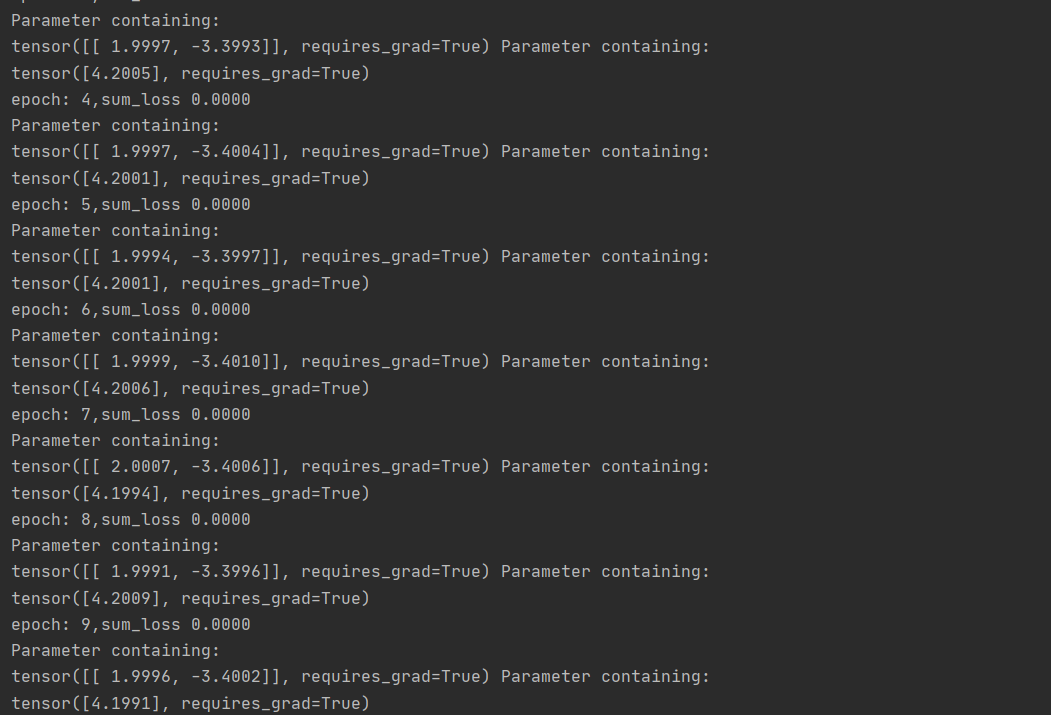
1. 本篇博客参照第四篇的步骤,使用pytorch实现的:
 1 import numpy as np
 2 import torch
 3 import torch.utils.data as Data
 4 from torch import nn
 5 import torch.nn.init as init
 6 # 数据集生成
 7
 8 num_inputs = 2
 9 num_samples = 1000
10 true_weight = torch.tensor([[2],[-3.4]])
11 true_bais = torch.tensor([[4.2]])
12
13 features = torch.randn(num_samples,num_inputs,dtype=torch.float)
14 labels = torch.mm(features,true_weight)+true_bais
15 labels += torch.tensor(np.random.normal(0,0.01,size=labels.size()),dtype=torch.float)
16 # 数据读取
17 batch_size = 100
18 train_data =Data.TensorDataset(features,labels)
19 dataiter = Data.DataLoader(train_data,batch_size,shuffle=True)
20 #for x,y in dataiter:
21     #print(y)
22 # 定义模型
23 class LineNet(nn.Module):
24     def __init__(self,n_features):
25         super(LineNet, self).__init__()
26         self.linear = nn.Linear(n_features,1)
27
28     def forward(self,x):
29         return self.linear(x)
30
31 net = nn.Sequential(
32          nn.Linear(num_inputs,1)
33         )
34 print(net[0])
35 #for params in net[0].parameters():
36     #print(params)
37 # 初始化模型参数
38 w = init.normal_(net[0].weight,mean=0,std=0.01,)
39 b = init.constant_(net[0].bias,val=0)
40 #定义损失函数
41 loss = nn.MSELoss()
42 #定义算法优化
43 optimzer = torch.optim.SGD(net[0].parameters(),lr=0.3)
44 #训练模型
45 def train_module(data_iter,epoches):
46     for epoch in range(epoches):
47         sum_loss,n = 0.0,0
48         for x, y in data_iter:
49             y_hat = net(x)
50             l = loss(y_hat,y.view(-1,1))
51
52             optimzer.zero_grad()
53             l.backward()
54             optimzer.step()
55             n += y.shape[0]
56             sum_loss += l.sum().item()
57         print(‘epoch: %d,sum_loss %.4f ‘%(epoch, sum_loss/n))
58         print(net[0].weight,net[0].bias)
59
60 train_module(dataiter,10)
2. 相关知识补充:
-
从上一节从零开始的实现中,我们需要定义模型参数,并使用他们一步步描述模型是怎样计算的。当模型结果变得复杂时,这些步骤变得更加繁琐。其实pytorch提供了大量的预定义的层,这使我, 只需要关注使用哪些层来构造模型。下面介绍pytorch更加简洁的定义线性回归。
-
首先导入torch.nn 模块,实际上,nn是neural network的缩写。该模块定义了大量神经网络的层,之前使用过的autograd,而nn就是利用autograd来定义模型。
-
nn的核心数据结构是Module,它是一个抽象概念,既可以表示神经网络中的某个层,也可以表示包含很多层的神经网络。
-
在实际使用中,通过会继承torch.Module,撰写自己的网络/层。一个nn.Module实例应该包含一些曾以及返回输出的前向传播(forward)方法.
1 # 定义模型
2 class LineNet(nn.Module):
3     def __init__(self,n_features):
4         super(LineNet, self).__init__()
5         self.linear = nn.Linear(n_features,1)
6
7     def forward(self,x):
8         return self.linear(x)
######重点:
还可以用nn.Sequential来更加方便的搭建网络,Sequential是一个有序的容器,网络层将按照在传入的Sequential的顺序依次被添加到计算图中:
 1 # 写法1
 2 net= nn.Sequential(nn.Linear(num_inputs,1)
 3                   # 此处还可以传入其他的层
 4                   )
 5 # 写法2
 6 net = nn.Sequential()
 7 net.add_module(‘linear‘,nn.Linear(num_inputs,1))
 8 # net.add_module .....
 9
10
11 # 写法3
12
13 from collections import OrderedDict
14
15 net = nn.Sequential(
16 OrderedDict([
17     (‘linear‘,nn.Linear(num_inputs,1))
18     # 其他的层
19
20 ])
21 )
22
23 print(net)
24 print(net[0])
25
26 Sequential(
27   (linear): Linear(in_features=2, out_features=1, bias=True)
28 )
29 Linear(in_features=2, out_features=1, bias=True)
30  for param in net.parameters():
31         print(param)
32 Parameter containing:
33 tensor([[-0.4229, -0.0282]], requires_grad=True)
34 Parameter containing:
35 tensor([0.0852], requires_grad=True)
#####上述写法:我一开始想访问每次2迭代后访问参数,用的net = LinearNet(num_inputs),没有想出来怎么访问,才使用的后面的这种方式,至于为什么这种方式可以,我也不知到,希望在后续的学习中可以了解到
原文:https://www.cnblogs.com/xingyuanzier/p/15187125.html
评论(0)