
树状数组小结
时间:2021-08-23 22:57:46
收藏:0
阅读:27
树状数组
时间复杂度
- 单点修改 O(logn)
- 区间查询 O(logn)
前置知识
lowbit()运算:非负整数x在二进制表示下最低位1及其后面的0构成的数值。
#define lowbit(x) x & -x
树状数组的思想
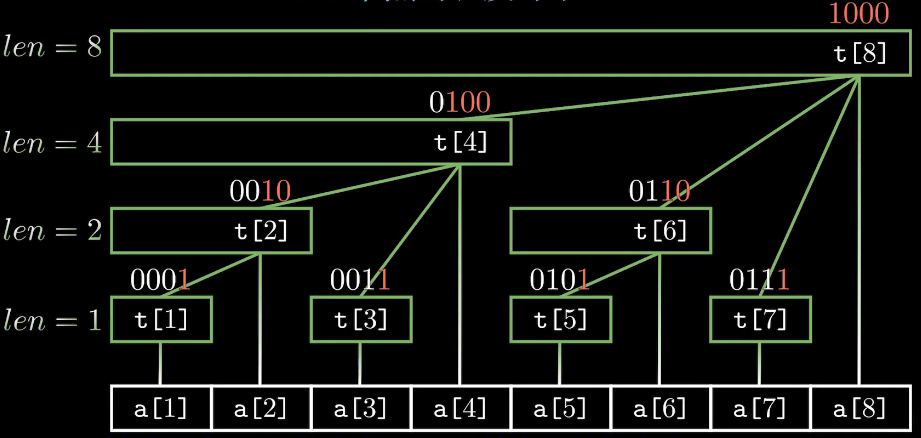
树状数组的本质思想是使用树结构维护”前缀和”,从而把时间复杂度降为O(logn)。
-
每个结点t[x]保存以x为根的子树中叶结点值的和
\[t[x]=a[x]+t[x-1]+t[x-1-lobit(x-1)]+...... \] -
每个结点覆盖的长度为lowbit(x)
-
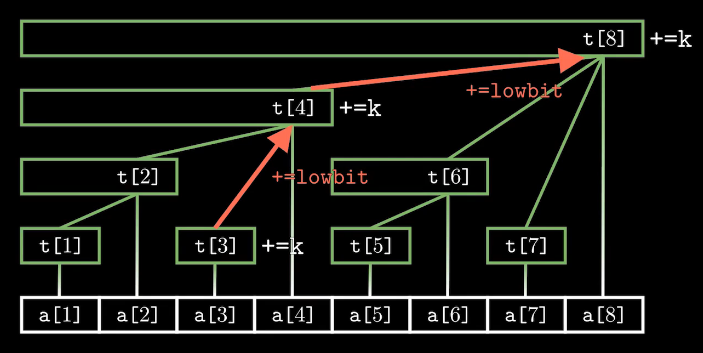
t[x]结点的父结点为t[x + lowbit(x)]
-
树的深度为log2n+1
树状数组的操作
add
-
add(x, k)表示将序列中第x个数加上k。
void add(int x, int k)
{
    for(int i = x; i <= n; i += lowbit(i))
        t[i] += k;
}
ask
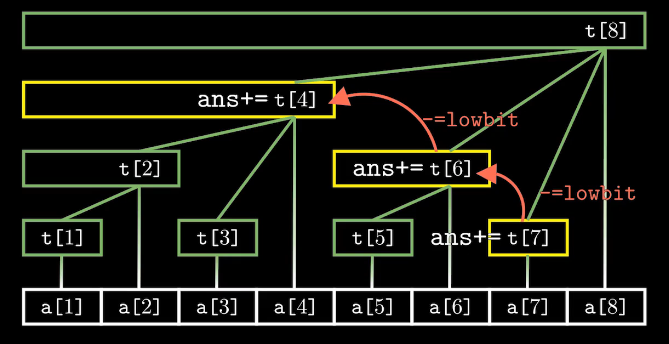
- ask(x)表示将查询序列前x个数的和
int ask(int x)
{
    int sum = 0;
    for(int i = x; i; i -= lowbit(i))
        sum += t[i];
    return sum;
}
树状数组的扩展
一:
-
修改区间和
-
查询元素
方法:构造tr为a的差分数组。
则
修改a区间[l,r]和<=>修改tr,tr[l]+c,tr[r+1]-c则
查询a[x]元素<=>求tr的1~x的前缀和#include<bits/stdc++.h> using namespace std; typedef long long LL; const int N = 1e5 + 10; int a[N]; LL tr[N]; int n,m; #define lowbit(x) x&(-x) void add(int x,int c) { for(int i=x;i<=n;i+=lowbit(i)) tr[i]+=c; } LL sum(int x) { LL res = 0; for(int i = x;i;i-=lowbit(i)) res+=tr[i]; return res; } int main() { scanf("%d%d", &n, &m); for(int i=1;i<=n;i++) scanf("%d",&a[i]); for(int i=1;i<=n;i++) add(i,a[i]-a[i-1]); while (m -- ) { char op[2]; int l,r,d; scanf("%s%d",op,&l); if(op[0]==‘C‘) { scanf("%d%d",&r,&d); add(l,d),add(r+1,-d); } else printf("%d\n",sum(l)); } return 0; }
二:
-
修改区间和
-
查询区间和

因此,我们维护两个树状数组
#include<bits/stdc++.h>
using namespace std;
typedef long long LL;
const int N = 1e5 + 10;
int n,m;
int a[N];
LL tr1[N],tr2[N];
#define lowbit(x) x&(-x)

void add(LL tr[],int x,LL c)
{
    for(int i=x;i<=n;i+=lowbit(i)) tr[i]+=c;
}

LL sum(LL tr[],int x)
{
    LL res = 0;
    for(int i = x;i;i-=lowbit(i)) res+=tr[i];
    return res;
}

LL ps(int x)
{
    return sum(tr1,x)*(x+1) - sum(tr2,x);
}

int main()
{
    scanf("%d%d",&n,&m);
    for(int i=1;i<=n;i++) scanf("%d",&a[i]);
    for(int i=1;i<=n;i++)
    {
        LL b = a[i] - a[i-1];
        add(tr1,i,b),add(tr2,i,b*i);
    }

    while (m -- ){
        char op[2];
        int l,r,d;
        scanf("%s%d%d",op,&l,&r);
        if(op[0]==‘C‘)
        {
            scanf("%d",&d);
            add(tr1,l,d),add(tr1,r+1,-d);
            add(tr2,l,d*l),add(tr2,r+1,(r+1)*-d);
        }
        else printf("%lld\n",ps(r)-ps(l-1));
    }
    return 0;
}
原文:https://www.cnblogs.com/aitejiu/p/15177662.html
评论(0)